
by Bob Paterson
Warlencourt-Eaucourt is a commune created over the centuries situated close to the Butte de Warlencourt and to the town of Bapaume which as many WW1 enthusiasts will know is located at the end of the D929 main Albert to Bapaume road. This commune saw serious fighting in WW1 and apart from the action at the Butte there was major action in the taking of Eaucourt Abbaye in October 1916.
Warlencourt meaning the ‘House of Warlon’, is the village situated across the road at the bottom of a man made hill called the Butte – a mound covering around a hectare of ground and the origins of which are distant and uncertain. Historians have defined the Butte as a hill made of stones and earth which contained several graves. These stones no doubt come from the neighbouring quarry very close to the Butte and on the right hand side of the pathway up to the entrance to the Butte. Today it gives the appearance of a wood. Archaeological searches in the middle of the seventeenth century revealed a sarcophagus containing several bones, arms and a helmet. Other archaeologists are of the opinion however that the Butte was a small fortress offering a perfect view over the Ancre valley, its strategic position was also said to be, that under the control of the Romans, the Butte was used to look over and protect the road from Bavay to Amiens. Finally, the idea that the Butte was the site of an old windmill cannot been discounted. As any visitor will know, it is certainly perfectly situated to make the most of the wind.
Eaucourt over the centuries had various names such as Aiulcurtis, Aecurtis and Yaucourt before settling on the current name Eaucourt from the middle of the eighteenth century. It was around the 11th century that l’Abbaye was built at the edge of Eaucourt. The era of increasing growth of cathedrals and crusades to the Holy land has arrived with the number of Abbeys in Christian territories increasing dramatically. Eaucourt had its place therefore in this exercise. After the agreement signed by Napoleon and Pope Pius 7th, l’Abbaye lived in tranquility until the arrival of the Great War in the area which saw the already started 1789 French Revolution damage and the destruction finally completed.
l’Abbaye was founded by the priest Odon who choose the life of a hermit however after a modest start Odon was not long in wanting to re-join his companions with the l’Abbaye then going under the rule of Saint Augustin. This rule involved a vigorous life fully dedicated to god which also saw the abolition of private property to the resulting profit of communal property. l’Abbaye lived of the fruits of its land and revenues and could accommodate and easily offer shelter to its neighbours in times of danger. Odon decided to place the L’Abbaye under the patronage of Notre Dame so the title of Notre Dame d’Eaucourt was born. A church was built by Abbe Baudouin during the 13th century which was to be the heart of the l’Abbaye site however after being destroyed the following century, it was rebuilt under the direction of architect Michel Diallet around 1600. The church which celebrated births, marriages and masses however was destroyed during the French revolution in 1795.
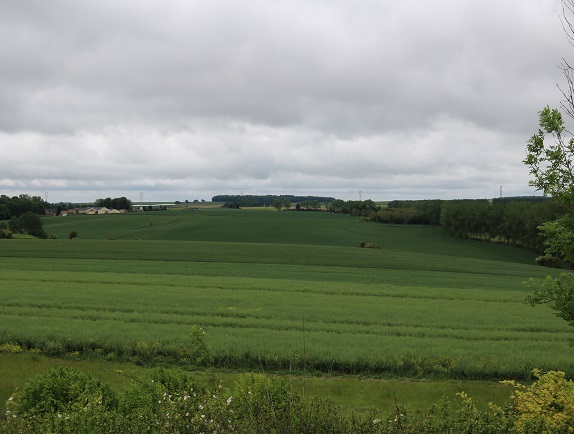
The picture shows the site of the current day l’Abbaye d’Eaucourt (top left) from the top of the Butte. This photo also shows the current day location of several important October – November 1916 action areas such as The Pimple, The Nose, The Tail, Snag Trench etc. The site of what was Eaucourt windmill is to the right of the farm buildings located just off the road to Le Sars.